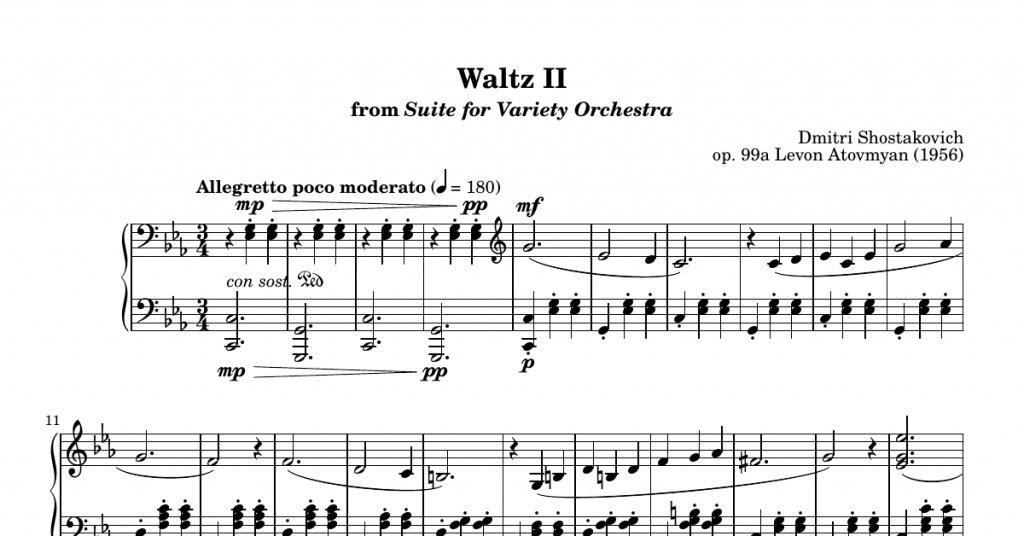
Waltz II op. 99 was composed by Dmitri Shostakovich beginning in 1955 for the film The First Echelon, premiering on April 29, 1956. That same year it was arranged by Levon Atovmyan as op. 99a to appear in Suite from The First Echelon. Late in that decade, op. 99a appeared as a piece in Suite for Variety Orchestra.
This waltz is a romantic formal piece that brings a sense of pleasure and innuendo to the ballroom, with a sort of faux nobility that originates in part from the choice of instruments (saxophone, trombone, accordion, harp). The dancers and spectators are kept engaged by a metronomically stable oom-pah-pah throughout.
I’ve produced an arrangement for the piano that tries to balance richness with playability, and without adding extra tones not in the orchestral score. It’s based on other prior arrangements (notably that of Andrea Tam), on the orchestral score, and on the YouTube recording published by The Wicked North that has over 100M views:
On the piano, it’s important to separate the consistent bass staccato from the consistent treble legato. One way to do this is to make heavy use of the sostenuto pedal. It can be held for most of the piece other than the refrain endings, with a quick toggle just as the first bass note of each measure is released. At the least, dextrous use of sostenuto enable one to maintain legato in the quasi trombone section, as the melody moves from hand to hand.
In the refrain endings of the main theme (consisting of thirds and octaves), I’ve recommended fingering that may seem odd at first, but which reinforces the specified phrasing that brings out each beat (in particular what would be the violin part). The octaves in the last measure of each refrain may be the trickiest part of this version.
Here is the score produced using LilyPond (4 pages, US letter size):
Here is a basic MIDI file generated by LilyPond. It’s won’t sound nearly as good as an acoustic piano performance because there is no sonority, no subtle tempo changes, missing or poorly actualized dynamics, etc. Even with its articulation module, LilyPond is somewhat lacking in that regard.
And here is an on-line MIDI player for instant gratification.
